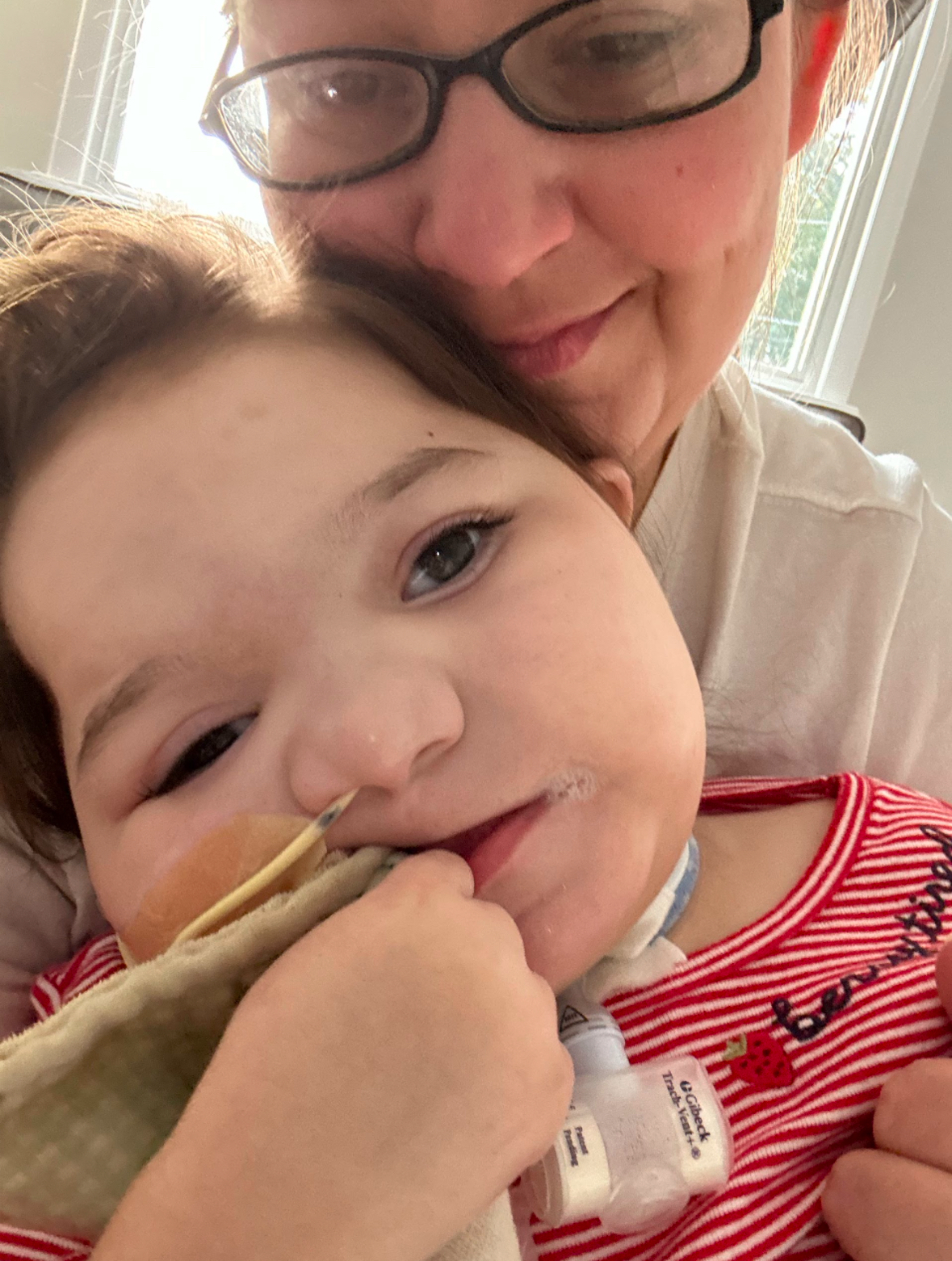
Published for Tracheostomy Awareness Week to help educate and reduce misconceptions about life with a tracheostomy.
Our Introduction to Trach Life
By the time Victory was 2 months old, we had already been living at the hospital 24/7 for weeks. We had learned more medical terminology than we ever imagined possible and honestly thought we had already faced the hardest parts.
Sadly, we were about to get a major wake-up call – literally.
It’s a very long story, but I’ll try to keep the short version short.
When Victory was about a month old, she had surgery to place her G-tube. To say it malfunctioned would be an understatement. What we were repeatedly told was “normal leaking” quickly became something much more serious. Over the course of a week, Victory became dangerously dehydrated and nearly lost her life.
The NICU team was unable to get an IV line into her to give emergency fluids, so they had to place what’s called an I.O. — an intraosseous line — where they drill directly into the bone to get fluids into the body quickly during an emergency.
As a parent, watching that happen to your baby is something you never forget.
Thankfully, they were able to stabilize her and save her life. But during everything that happened, she suffered several seizures and had to be intubated in order to help manage her airway and stabilize her medically while they tried to fix the G-tube situation.
Once she was intubated, the team attempted several times to extubate her, but each time she would continue to code and require resuscitation. We eventually learned that she was struggling significantly with swallowing and secretion management. After the severe dehydration, her secretions had become even thicker, and despite suctioning attempts, we simply could not safely clear and protect her airway well enough.
The only safe long-term option was a tracheostomy.
Before Victory’s Trisomy diagnosis, the only time I had ever even heard about trachs was in anti-smoking commercials on TV. I genuinely had no idea children could even have them.
After learning Victory might have Trisomy 13, I started researching more and noticed many children with Trisomy 13 had trachs — but I still hoped and prayed she would never need one.
In fact, right before her G-tube surgery, I remember saying to my husband, “G-tubes are so common — almost all kids with Trisomy 13 have them. But at least she doesn’t need a trach.”
Well… I definitely lived to eat those words.
But looking back now, I can honestly say I’m incredibly thankful for her trach. It gave her a safe airway, more stability, and ultimately helped give us more time with our little girl.
What a Trach Actually Is
A tracheostomy, often called a “trach,” is a surgically created opening in the neck that allows direct access to the airway through the trachea (windpipe). A small tube is placed into that opening to help a person breathe safely and more effectively.
People can need trachs for many different reasons, and not every trach story looks the same.
Some children and adults need a trach because they cannot safely protect their airway on their own. Others may need one because of chronic lung disease, airway abnormalities, neurological conditions, severe sleep apnea, vocal cord paralysis, ventilator dependence, or difficulty managing secretions.
For some people, a trach is temporary and can eventually be removed once their condition improves. For others, it becomes a long-term or lifelong part of daily life.
One thing I wish more people understood is that a trach is not automatically a “worst case scenario.”
In many situations, a trach actually improves quality of life.
It can provide a safer airway, better oxygen support, more stable breathing, improved sleep, fewer emergencies, and in some cases even allow someone to finally leave the hospital and go home with their family.
For children who require ventilator support, a trach can also be a much safer and more comfortable long-term option than remaining intubated with a breathing tube through the mouth or nose.
Most importantly, a trach is a medical tool — not a definition of a person.
A child with a trach is still a child first.
They still have personalities, favorite toys, opinions, routines, giggles, attitudes, and dreams. The trach may be part of their story, but it is not who they are.
For a more detailed medical explanation of what a tracheostomy is and why it may be needed, Johns Hopkins Medicine offers a helpful overview.
Common Trach Myths
There are so many misconceptions surrounding trachs, especially when people have never personally known someone with one. Before Victory, I honestly believed some of these myths too.
Myth: “A trach means someone is dying.”
Reality:
A trach is often used to help stabilize and protect someone’s airway — not because they are dying. In many cases, it actually improves safety, breathing, and quality of life. It actually SAVES a life!
For some children and adults, a trach can reduce emergencies, improve oxygen levels, help with secretion management, and even make it possible to finally leave the hospital and go home.
Myth: “Kids with trachs can’t have a good quality of life.”
Reality:
Life may look different, but different does not mean less meaningful.
Trach kids still laugh, learn, play, love, celebrate milestones, and bring incredible joy to the people around them. They still have personalities, favorite things, and full lives worth living. I’ve even heard someone this week say that since their child got a trach, the child is doing things she has not done in months and some things that she never done before! She actually can DO things because she is not so focused on breathing and surviving!
The medical equipment may be more visible, but it does not erase the child underneath it.
Myth: “They can’t make sounds or communicate.”
Reality:
Many children with trachs absolutely can communicate — whether through vocalizations, speaking valves, facial expressions, sign language, AAC devices, body language, or other forms of communication.
Communication does not only look one way.
Some trach patients can speak verbally, while others communicate differently. Either way, they still have thoughts, feelings, opinions, preferences, and personalities that deserve to be heard and respected.
Myth: “A trach means life stops.”
Reality:
A trach changes life, but it does not end it.
There are still birthdays, family traditions, bedtime routines, movie nights, therapy wins, funny moments, and everyday memories being made.
Yes, there are harder days.
Yes, there are challenges.
Yes, there is more planning involved.
But there is also still life — beautiful life — happening in the middle of it all.
Myth: “Trach kids are always in the hospital.”
Reality:
While many children with trachs do spend significant time hospitalized, especially early on, many also live at home, go to school, attend therapies, travel, participate in activities, and experience life outside hospital walls. In our experience, it actually keeps Victory OUT of the hospital, by being able to manage her airway and ventilator support at home and not have to go in and be admitted if she needs oxygen for example.
You may see the trach first, but eventually it simply becomes part of the child — like glasses, a wheelchair, or any other medical support tool.
At the end of the day, a trach is simply an airway.
It is not a limitation on someone’s worth, personality, joy, or ability to be deeply loved.
The Reality of Daily Care
One thing I didn’t fully understand before entering the trach world is that trach care is so much more than just the trach itself.
Yes, there’s the direct care — suctioning, cleaning, trach changes, humidification, monitoring, and equipment setup — but there’s also an entire invisible layer of responsibility constantly running in the background.
Suctioning is one of the biggest parts of daily life for many trach families. Some days we barely need to suction at all, and other days it feels constant, especially during illness or increased secretions. Suctioning helps clear mucus and secretions from the airway so breathing stays safe and comfortable.
Then there’s cleaning and routine care. The trach site has to stay clean and dry to help prevent irritation, breakdown, and infection. Equipment has to be cleaned regularly too — tubing, humidification setups, suction supplies, and more. It’s amazing how quickly medical equipment can completely take over parts of your home.
Humidification is another huge part of trach care that many people don’t realize. Normally, our nose and upper airway help warm, filter, and humidify the air we breathe. With a trach, that process is bypassed, so extra humidification is often needed to help keep secretions thinner and easier to clear.
And then there’s the monitoring.
Pulse ox monitors.
Vent alarms.
Oxygen levels.
Heart rates.
Breathing patterns.
Watching for changes in color, sounds, secretions, or effort.
You become hyper-aware of every little sound and every little change.
Machine alarms become part of daily life too. Some alarms are minor and routine. Others make your heart stop for a second before you even fully wake up. Over time, you learn the difference between “fix it in 2 seconds” alarms and “move immediately” alarms — but your nervous system still reacts every single time.
Nighttime care is often one of the hardest parts.
Even while sleeping, there’s still listening.
Monitoring.
Checking positioning.
Responding to alarms.
Making sure the airway stays clear and safe.
You learn to sleep lightly when your child’s breathing depends on equipment, monitoring, and quick responses.
If I could give one piece of advice to newer trach families, it would be this: if overnight nursing is an option available to you, pursue it.
Even if you only qualify for nights, it can make an enormous difference.
Sleep deprivation affects everything — physically, emotionally, mentally, and spiritually. When you are constantly “on alert,” it doesn’t take long before exhaustion starts affecting every part of life.
That being said, trust matters deeply when it comes to overnight care.
When your child depends on airway management and medical equipment, you need nurses who are attentive, hands-on, fully awake, and genuinely invested in your child’s safety. Finding those nurses can sometimes take time, and not every fit will be the right fit right away.
But those truly incredible nurses — the ones you trust enough to finally close your eyes and sleep — are absolute diamonds in the rough.
And when you find them, they become such an important part of your child’s care team and your family’s ability to function long-term.
And honestly, one of the biggest things I’ve learned is this:
The trach itself may only take minutes to care for — it’s managing everything around it that becomes a full-time job.
There’s also the endless supply management that nobody really prepares you for. Ordering supplies, tracking inventory, dealing with shortages, insurance approvals, backorders, missing shipments, broken equipment, and trying to make sure you never run out of something your child medically depends on can become a job all on its own.
Trach life requires constant preparation, constant awareness, and constant adaptability.
But over time, somehow, the routines that once felt terrifying- slowly become part of normal everyday life.
Emergency Preparedness
One thing that changes quickly when your child has a trach is the way you leave the house.
Honestly, we don’t really leave home casually anymore.
Most families grab their keys, wallet, maybe a diaper bag, and head out the door. Medical families often leave the house carrying what feels like a mini ICU.
Every outing requires planning.
Before leaving, we have to think through things most people never even consider:
Do we have enough suction supplies?
Are the emergency trachs packed?
Is the portable suction machine charged?
Do we have extra batteries?
Backup oxygen?
Pulse ox monitor?
Extra tubing?
Emergency supplies?
What’s the closest hospital?
How long will we be gone?
And then we double check everything again.
Emergency bags become a normal part of life for trach families. Ours goes almost everywhere with us because airway emergencies can happen quickly and without warning. Inside are things like spare trachs, suction catheters, lubricant, saline, emergency equipment, and other supplies needed to keep Victory safe if something unexpected happens.
One of the most important things we carry is a spare trach — actually, multiple spare trachs in different sizes. If a trach accidentally comes out or becomes blocked, replacing it quickly can become an emergency situation.
We also travel with suction equipment everywhere because keeping the airway clear is critical. Secretions can build up fast, especially during illness, and suctioning is often necessary to help maintain safe breathing.
Then there’s the Ambu bag (also called a manual resuscitation bag), portable oxygen, pulse ox monitors, and all the equipment that helps us monitor and respond quickly if something changes.
Over time, packing and preparing becomes second nature. You learn to think ahead constantly because preparation is part of keeping your child safe.
We actually always keep a fully stocked emergency bag ready to go at all times. So when we need to leave — whether it’s an emergency trip or just a simple walk outside — we grab the bag, her charged portable suction machine, and her charged portable ventilator, and we’re out the door.
We also keep an Ambu bag and oxygen already set up in the car so we’re not scrambling in a moment of stress.
It might sound intense from the outside, but for us it’s just how we stay ready. Prepared doesn’t mean panicked — it means we can actually go and live life without having to start from scratch every time we leave the house.
If you’re a medical parent trying to figure out your own setup, I’ve also created a GO BAG checklist you can use to help make packing and preparing a little easier. You can grab it here.
And while it can feel overwhelming at times, it also becomes part of your normal.
You adapt because you have to.
What once felt terrifying eventually becomes the routine rhythm of everyday life as a medical family.
The Emotional Side of Trach Life
This is the part of trach life that people don’t always see — but it’s often the heaviest part to carry.
Because beyond the machines, supplies, and routines, there’s a constant emotional awareness that never fully turns off.
Fear becomes something you learn to live alongside, especially in the beginning. Not a constant panic, but a quiet awareness that emergencies can happen quickly and without warning.
Hypervigilance becomes normal. You notice sounds other people wouldn’t think twice about. You wake up easily. You listen differently. You scan for changes without even realizing you’re doing it.
Sleep deprivation often becomes part of the rhythm of life. Even when you’re exhausted, your body stays partially alert, especially during illness or more unstable seasons.
There’s also the anxiety that comes with sickness — even a simple cold can feel very different when airway support is involved. What might be minor for one child can become something that requires close monitoring and quick response.
And with all of that comes responsibility. A deep, constant awareness that you are one of the primary protectors of your child’s airway and safety. That weight doesn’t fully go away, even on good days.
Over time, you do learn to trust yourself more. You grow into skills you never asked for, and you begin to recognize what is “normal” for your child versus what needs attention. That confidence builds slowly, through experience, repetition, and hard moments you didn’t choose but learned from anyway.
And somehow, in the middle of all of it, you also learn to hold both gratitude and exhaustion at the same time. Deep thankfulness for your child’s life and progress… while also acknowledging how heavy the journey can feel.
What We Wish People Understood
If there’s one thing I wish more people truly understood, it’s this: kids with trachs are still kids first.
They are not their equipment. Not their diagnosis. Not their medical chart. They are children who laugh, play, learn, get silly, get tired, and have full personalities just like any other child.
Most families are not looking for pity. We’re not asking anyone to feel sorry for us or our children. What we do appreciate — deeply — is understanding, respect, and basic human kindness.
Inclusion matters more than people realize. Sometimes it’s the simple things: inviting a child to participate, talking to them directly, or not assuming what they can or can’t do. Small moments of inclusion can mean everything to a family who is often navigating a very different world.
And yes — staring can hurt. Most medical families get used to being noticed, but that doesn’t mean it doesn’t affect us. A quick glance is one thing, but prolonged staring or whispering can feel isolating for both the child and the parent. A smile, a wave, or a kind word always goes further than a stare.
Medical moms and dads carry a mental load that is often invisible. It’s not just the physical care — it’s the constant thinking ahead, planning, monitoring, advocating, tracking supplies, managing appointments, and staying emotionally alert at all times. It’s a weight that rarely gets seen, but is always there.
There are also simple ways people can support medical families: offering patience, asking how to help instead of assuming, respecting routines, and showing genuine kindness without needing to fully understand the medical details.
There is also a difference between respectful curiosity and intrusive questions. Thoughtful, kind questions from a place of genuine care can be meaningful. But families are not required to educate in every moment, especially when they are simply trying to manage their day.
One thing I gently want to say to parents who may be walking toward this decision is this: if a tracheostomy is being seriously recommended for your child, don’t be afraid of it out of fear or misconception.
I’ve seen so many families wait — sometimes for a long time — holding onto fear of what a trach means, only to later realize it could have brought their child more stability, safety, and comfort much earlier.
Of course, every child and situation is different, and these decisions are never simple. They are deeply personal and made alongside medical teams who know your child’s specific needs.
But from our experience, I can say this with confidence: a trach can be life-giving. It can be life-saving. And in many cases, it can significantly improve both the quality and quantity of life for a child who truly needs it.
It is not something to fear in the way it is often portrayed. For many families, it becomes the bridge that allows their child to finally breathe more safely and come home to live their life outside of the hospital.
To other parents walking this road — you are not alone. Even on the hardest days, even when it feels isolating, there is a whole community of parents who understand the weight you’re carrying without needing every detail explained.
And if no one has told you lately — you are doing better than you think.
Who Victory Is Beyond Medical Equipment
At the end of all of this — beyond the trach, the ventilator, the monitors, the supplies, and the medical terms — there is Victory.
And she is so much more than any of it.
She has a personality that fills a room in ways no machine ever could. She has her own little ways of communicating, her own preferences, her own reactions to life around her. She notices things. She responds in her own unique way. She has opinions, moods, and a presence that is completely hers.
She has things she loves — the comfort items that make her calm, the sounds that make her light up, the routines she recognizes, the people she knows and trusts. She has favorites, just like any other child. And when she is happy, you feel it in every part of her.
She also has those funny little habits that only a parent truly notices — the expressions that make you laugh, the timing of her reactions, the little personality quirks that become part of your everyday life and make you smile even on hard days.
And underneath everything medically complex, there is incredible strength. Not just physically, but in the way she shows up in her own life every single day. In the way she keeps going. In the way she continues to grow, learn, and experience the world in her own way.
But what stands out the most is the joy she brings.
Not just to us — but to the people who meet her, care for her, and love her. There is something about her presence that reminds you what really matters.
Because she is not her equipment.
She is not her diagnosis.
She is Victory.
And the trach is just one small part of her story — not the whole story.
Why Awareness Matters
Awareness matters because understanding replaces fear.
So much of what people fear about trachs comes from not knowing what they actually are or what life with one really looks like. But when people learn, even a little, it changes how they see children and families walking this road.
To other trach families and medical parents — you are not alone. Even on the days that feel isolating, there is a whole community of people who understand the weight you’re carrying without you needing to explain every detail. You are doing far better than you often feel you are.
To everyone reading — compassion and inclusion go further than most people realize. A little patience, a kind word, or simply seeing a child as a child first can leave a lasting impact on a family who already carries so much.
And to the medical professionals and caregivers who walk alongside families like ours — the nurses, therapists, doctors, and support teams — your work matters more than words can fully express. The care, skill, and compassion you bring often becomes part of a family’s survival and stability.
Most of all, medically complex children are valuable, worthy, and deeply loved. Their lives are not defined by equipment or diagnoses. They are defined by who they are — and by the love that surrounds them.
A trach may change how someone breathes — but it does not change their worth, personality, or ability to bring light into the world.
If you’d like to learn more about tracheostomy awareness, education, and safety initiatives, you can visit the Global Tracheostomy Collaborative.
Final Thoughts
If this helped you better understand life with a tracheostomy, feel free to share it to help spread awareness.
Awareness grows when we talk about the things most people never see.
And if you’re a medical parent or trach family walking this road, I’d truly love to hear from you — you are not alone, and your story matters too.
For families navigating a Trisomy diagnosis, the Support Organization for Trisomy (SOFT) offers support, resources, and community for parents and caregivers.
If this message encouraged you, we’d also love to hear your story or pray with you. You can email us at [email protected] — your story may be exactly what someone else needs to read today.
And be sure to follow us on Facebook at Living with Victory for more encouragement, updates, and real-life faith-filled moments from our journey.
Together, we can remind each other that even in the hardest moments, God is still working all things for His glory. 🌿